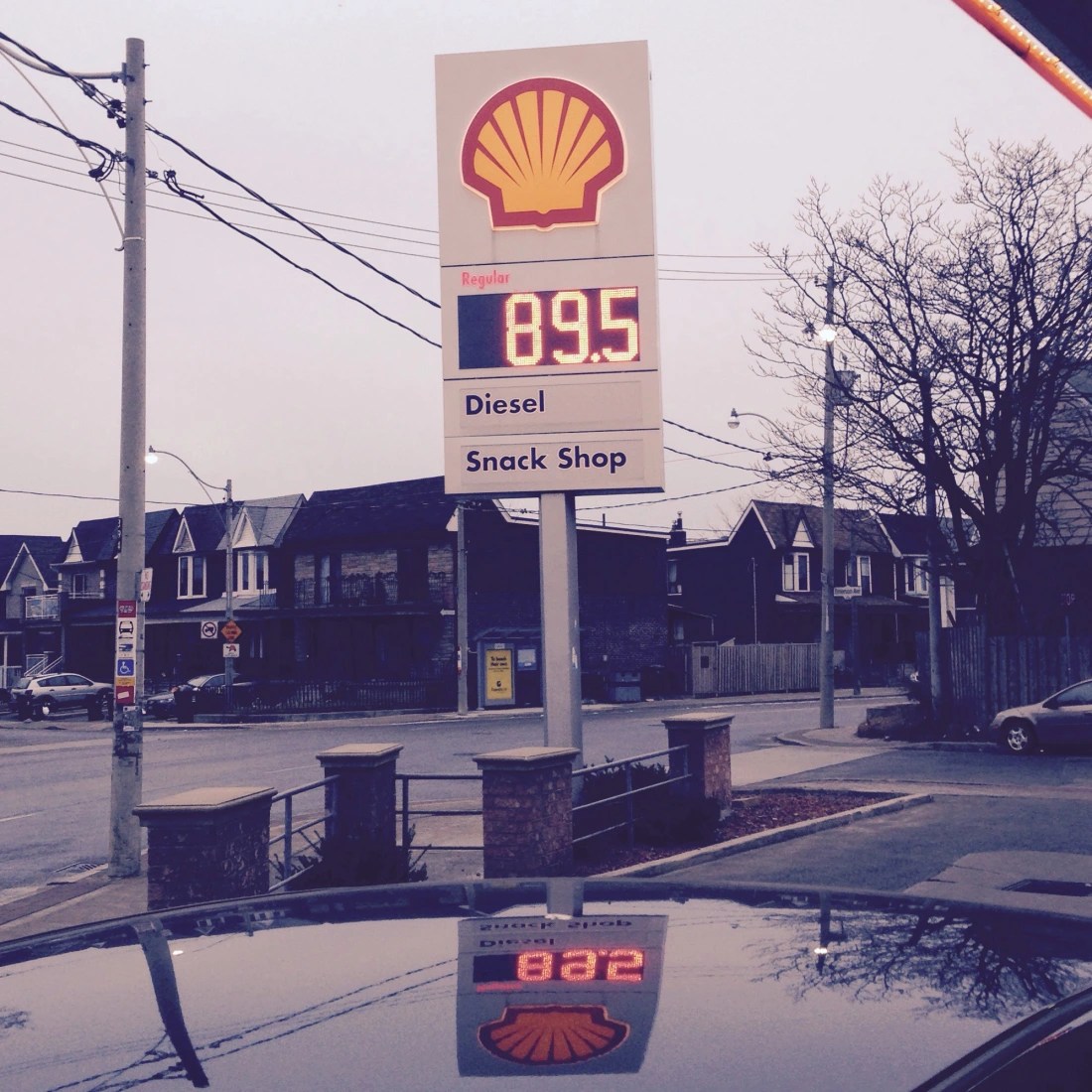
Today, I did something that I haven’t done since my family got our first car four years ago – I filled up the tank with sub-90-cent gas. Oddly, in addition to feeling the obvious joy for saving money, I felt a momentary sense of worry about turning into a liberated gas-guzzler. Like many others, my driving habits reflected the tough times of $1.30/L fuel – I drove less, travelled to more local options, and conserved gas however I could (e.g. opening the windows instead of using the air conditioning). Now that gas feels like a bargain, I fear that I and others like me will start taking long joy rides with the AC blasting for no good reason (even in the dead of winter), and in so doing, contribute even more of those nasty greenhouse gases I’ve heard a bit about to Mother Earth. After all, the whole reason fuel-efficient, hybrid and electric cars came to be is due to the economic pressures that came with high fuel prices, and not for any environmental considerations. Money drives behaviour, unfortunately. When it comes to low gas prices, it’s not all roses and rainbows.
So what’s the educational spin in all this? Students should be encouraged to explore all sides of any issue. Role playing and debating are some simple ways to promote critical thinking. This coming semester, I’ll be incorporating social justice issues into math, and no doubt there’ll be some serious debating happening.
In the meantime, I’ll try to enjoy the low gas prices and, well, walk, We’ll see how that goes, as I stare at a snowstorm out the window.
I am a high school mathematics teacher who’s taught primarily in the northwest corner of Toronto. Currently, I serve as the Coordinator of Secondary Mathematics and Academic Pathways in the Toronto District School Board. My role is to support the TDSB with challenging academic streaming from K-12, paying particular attention to inclusive and culturally responsive mathematics instruction. I view math education through the perspective of equity, inclusion and anti-oppression and its intersection with student identities. As a powerful tool and vehicle for social change, I see math as student empowerment and ensure they see its learning as a social enterprise that challenges them to think critically and collaboratively.
I am also a staunch advocate for the elimination of streaming in education — that is, the separation of students into distinct learning pathways based on students’ perceived abilities and identities. I have worked at the school and system levels to support teachers with inclusive math practices and shape policy to remove streaming as a structure barrier to equity and inclusion. I also serve on the steering committee for the Coalition for Alternatives to Streaming in Education, or CASE, a grassroots alliance of community groups wanting to see changes to streaming structures in the school system.
My passion for equity and anti-racism led me to co-author Addressing Anti-Asian Racism: A Resource for Educators, which provides a historical context for anti-Asian racism, the need to work in allyship to dismantle anti-Black and anti-Indigenous racism by tackling white supremacy, and gives teachers and principals practical steps to make anti-oppressive educational spaces.
When I need to step away from the world of education, I play NHL94 for the Super Nintendo, where I compete online as TheProfessor and ranked in the top 5 on Earth (yes, my proficiency in a 25+ year-old video game is an integral part of my identity). My family and friends fit in there somewhere too.
Connect with me on Twitter: @Jason_To
View all posts by Jason To

 Jason To