
Part 1 – Why It’s Just the Worst.
“Saida, I really think you should to go to Applied math.”
Even just thinking about my comment to this Grade 9 student years ago still makes me cringe. I remember it so vividly. We were standing outside the math office between periods at Westview Centennial Secondary School where I was the head of math. Saida was wearing a bright yellow hijab and holding her coiled Hilroy notebook and textbook on her hip. My back was facing the office door, and my shoulders were slightly hunched over, anticipating that she’d get upset over what I was suggesting.
After I said my piece, Saida shook her head and looked away. She made a face that clearly demonstrated disapproval, turned around, and slowly walked away from me.
Eventually, after a conference with Saida’s mother, she did transfer to Applied math. I felt that I was selflessly doing her a favour by moving her to a class where she could attain a feeling of success, while also absolving her of her unrealistic dreams of becoming a doctor. In hindsight, I was doing myself a favour, relieving me of both a burden and a feeling of failure.
Weeks afterwards, I received an email welcoming me to a professional learning series that the organizers titled Sifting, Sorting and Selecting: Rethinking Streaming in TDSB Schools. As the math lead, I was expected to attend. Even after reading the introductory email, I honestly had no clue what this PD was for.
What’s streaming? And why do I have to rethink it?
At that early point in my career, I had a pretty strong but unrefined equity lens. I did my teacher education through OISE’s Inner City Education Cohort, and I began my teaching career in northwest Toronto. When I was offered a position to be a school leader at Westview, the heart of the Jane and Finch community, I couldn’t resist the opportunity. I wanted to make a difference.
In the case of Saida, along with likely many other students up until that point, I didn’t know that sometimes I would be making the wrong kind of difference.
What transpired over the next few months through Sifting, Sorting and Selecting was nothing short of my mind being blown and my self-conceptions as an educator irreversibly shaken. I often refer to this as my red pill moment. I learned about power and privilege, how my own identity shaped how I taught and for whom I taught, factors that actually impact student achievement and realizing that almost all of them were, to varying degrees, within my control. I analyzed demographic data from Gillian Parekh’s seminal report on streaming and how these streams not only perpetuated societal inequality but could actually be exacerbating them. I saw the potential of alternative models of schooling, like one piloted in Limestone District School Board. I heard from Carol Burris, then a school leader in a New York district that ended streaming, invested in teacher learning, and saw incredible academic gains for their Black and Latino/a populations.
After this mind warp, myself and my Westview colleagues drew up a plan to destream Grade 9 English and math (yes, this grand plan was hatched using a Crayola marker and chart paper):
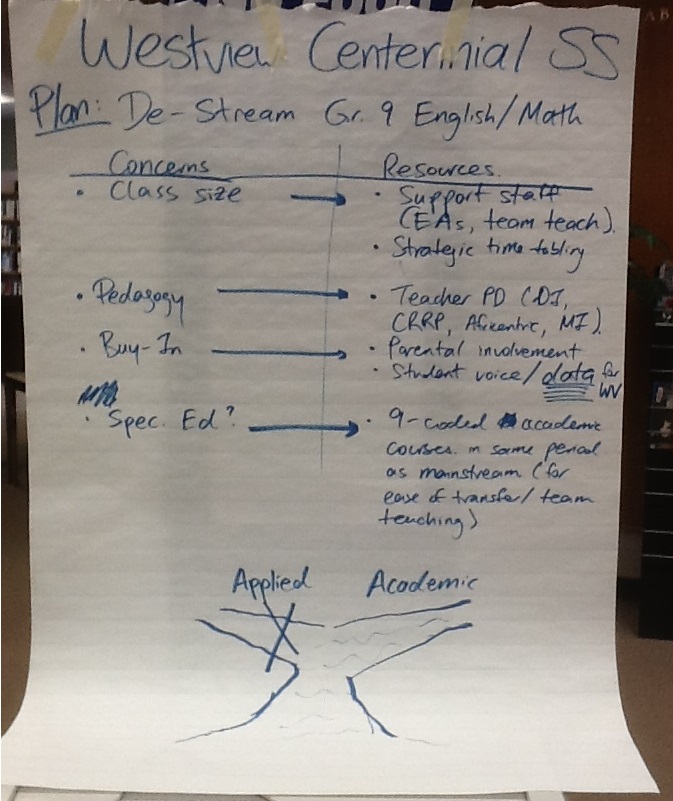
We had a will. And we had a way — sort of. What we knew for sure, however, was that the status quo could no longer be upheld and that we needed to change course. We were all willing to learn more to make destreaming viable and successful. The next year involved professional inquiries: differentiating instruction to respond to varying student readiness, offering culturally relevant texts and plays, and teaching issues of social justice and providing open questions and parallel tasks in math. The specific strategies are not the point here (that’s really for Part 3). What matters is that we teachers really wanted destreaming to work and were enabled by our school administrators to try new things and take risks in our practice.
In a span of five years, I went from being a teacher who actively pushed students out of Academic to relishing the opportunity to include students into my Academic math classes that were previously excluded, such as those identified with a mild intellectual disability. It all began with a mindset change, sustained by a motive to be an anti-racist, and refined over time through ongoing learning and inquiry. To me, that’s the secret to being a successful teacher in a destreamed system. I am not a perfect teacher by any means, nor do I ever expect to become one. I do, however, expect myself to continually be better, because inclusion and anti-oppression are not static events, but rather a constant process of building and re-building.
On a June Monday, Ontario Premier Doug Ford gave his take on racism in Canada compared with that of the United States, saying that “We don’t have the systemic, deep roots they’ve had for years.”
Perhaps after an explanation from experts within his inner circle, he acknowledged three days later that “We have our own history of racism here in Ontario and it’s been going on for decades.”
A month later, Ford announced his government will end academic streaming in Grade 9 across the province, noting it as a form of systemic racism: “We are the only province in the entire country that does this and it really is not fair to certain groups of students.”
That red pill, Mr. Premier, is something else, isn’t it?
Shout-out to the Sifting, Sorting and Selecting team members: Ramon San Vicente, Alison Gaymes San Vicente, Diane Dei Amoah, Cristina Guerrero, Tracy Williams-Shreve, Amita Hamda, Kevin Sutton, Sandra MacInnis, and John McPhee. Read their report here.
More shout-outs to the Westview team that hatched the destreaming plan on chart paper and blue Crayola marker: Rosalie Griffith, Nastassia Subban, Saraya Elwin, Nalinee Dindial, Pamela Townsend, Cherilyn Scobie, Bruno Berto, and Charmine Gayle-Bonner
 Jason To
At Westview, we are still streaming for EQAO purposes. Check EQAO website
In 2016, we ran an 2 Grade 9 Applied math sections only for students who failed the previous year (that was a bad idea). When I left Westview, streaming crept back in. I take responsibility for not adequately explaining the rationale behind destreaming to staff. If EQAO ran this year, we would have had all students write the Academic EQAO.
Hi Jason. This is really great. Thanks for sharing your experiences at Westview. It sounds like you and your colleagues spent a lot of time and energy discussing, planning, and implementing destreaming. You did it right. What you’ve demonstrated here is that with the proper leadership and supports, teachers can make this shift happen.
Our experience at CTS has been completely different. In fact, we’ve been the model for how NOT to undertake a challenging process. We tried to take our concerns to TDSB leadership but none of them were ever addressed. The biggest problem has been lack of strong leadership from our SO to some of our PORs. This, along with sloppy implementation and lack of support, has really affected the morale and health of our staff.
Please take this into account when you address teachers who may be having a hard time with destreaming. The message about how to transition successfully has to be heard by school board leadership teams. It’s not enough to applaud the idea, delegate the practical implementation, and leave teachers holding the bag without proper supports.
Bruno Berto was a POR of spec ed at CTS for a short time a almost 10 years ago, by the way. 🙂
I teach students on the ASD spectrum and agree with the word “mindset”. In everything we teach, our “attitude” is what makes or breaks our ability to be successful teachers.
Really enjoyed Jason sharing , his dedication and passion are inspiring