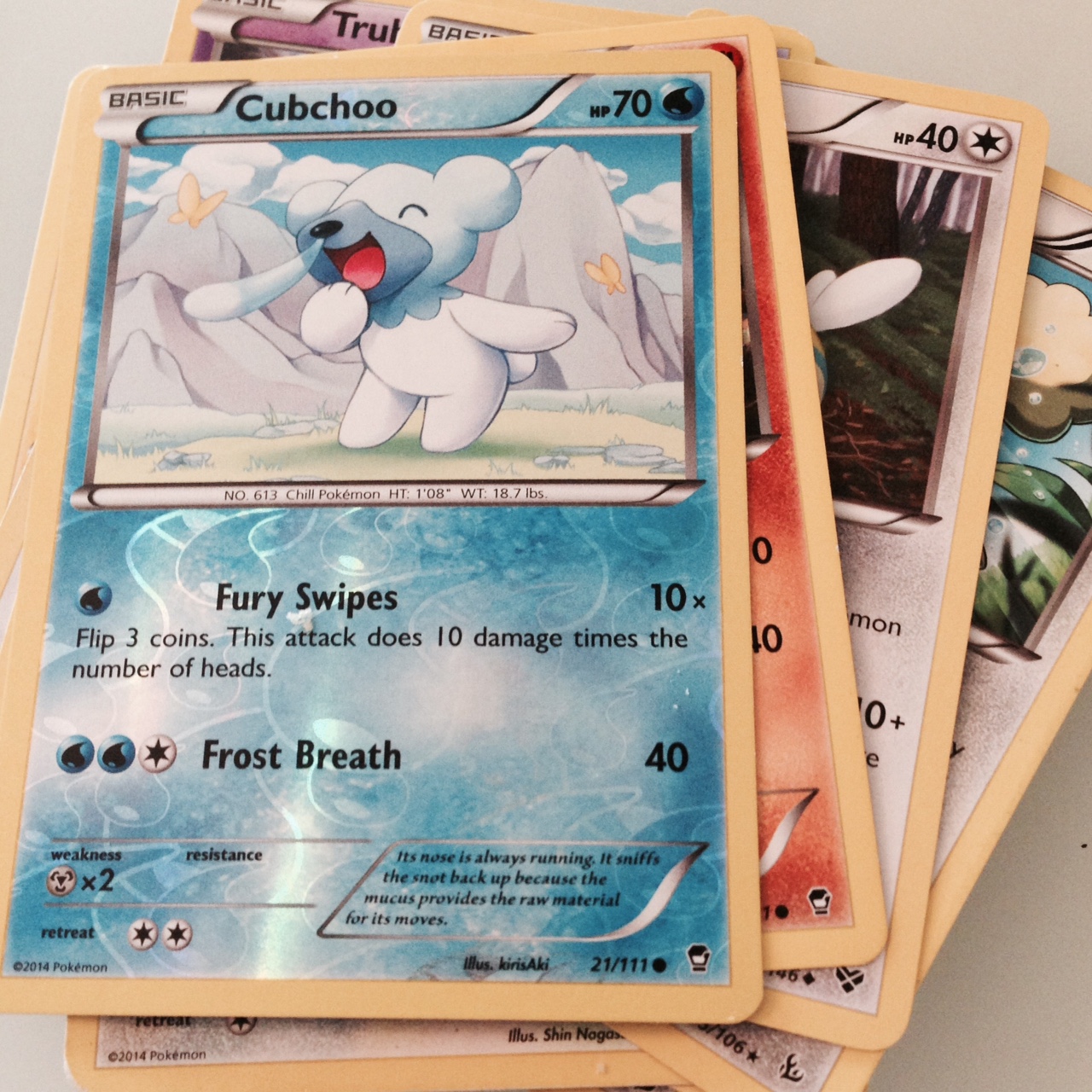
If you are like me and a proud parent of a 7-ish year-old boy, you’ve no doubt encountered Pokemon cards – you may have even been completely into them yourself as a youth (personally, I was more into Power Rangers). These cards with pictures of strange animal-like creatures are part of a trading card game similar to Magic, and my son LOVES them. So, why not try to make the most of this often expensive interest and make it educational? For the past few months, rather than playing the real rules of the card game, we play with them by taking turns “battling” each other’s Pokemon with their attacks and associated amount of damage until the opposing Pokemon’s health points (HP) are reduced to zero. Needless to say, this involves plenty of subtraction using mental math. I’ve noticed that after several months of playing, my son’s subtraction skills are getting stronger – he even explains what he’s doing in his head after each calculation. Plus, he’s willing to do this for, like, an hour or two. It’s amazing how much learning kids will do if the activity is a game or using something that they’re totally interested in. That’s what I’ll be bringing back to my classroom after the winter break. Whether it’s basketball, dancing, or Pokemon cards (my Grade 9s LOVE Pokemon, too), make math fun and relevant.
I am a high school mathematics teacher who’s taught primarily in the northwest corner of Toronto. Currently, I serve as the Coordinator of Mathematics and Numeracy in the Toronto District School Board. My role is to support the strategic improvement of mathematics teaching and learning for Kindergarten to Grade 12 students. I view math improvement and student excellence through the perspective of equity, inclusion and anti-oppression and its intersection with student identities. I also view math improvement through systems thinking and large-scale change management.
I am also a staunch advocate for the elimination of streaming in education — that is, the separation of students into distinct learning pathways based on students’ perceived abilities and identities. I have worked at the school and system levels to support teachers with inclusive math practices and shape policy to remove streaming as a structure barrier to equity and inclusion. I served on the steering committee for the Coalition for Alternatives to Streaming in Education, or CASE, a grassroots alliance of community groups wanting to see changes to streaming structures in the school system.
My passion for equity and anti-racism led me to co-author Addressing Anti-Asian Racism: A Resource for Educators, which provides a historical context for anti-Asian racism, the need to work in allyship to dismantle anti-Black and anti-Indigenous racism by tackling white supremacy, and gives teachers and principals practical steps to make anti-oppressive educational spaces.
When I need to step away from the world of education, I play NHL94 for the Super Nintendo, where I compete online as TheProfessor and am a 3-time world champion (yes, my proficiency in a 25+ year-old video game is an integral part of my identity). My family and friends fit in there somewhere too.
Connect with me on
BlueSky: @mrjasonto.com
Instagram: @mrjasonto
LinkedIn: Jason To
X: @Jason_To
View all posts by Jason To
Published
One thought on “Math with Mewtwo – Learning math using Pokemon TCG Cards”



how do u reduce to zero with pokemon