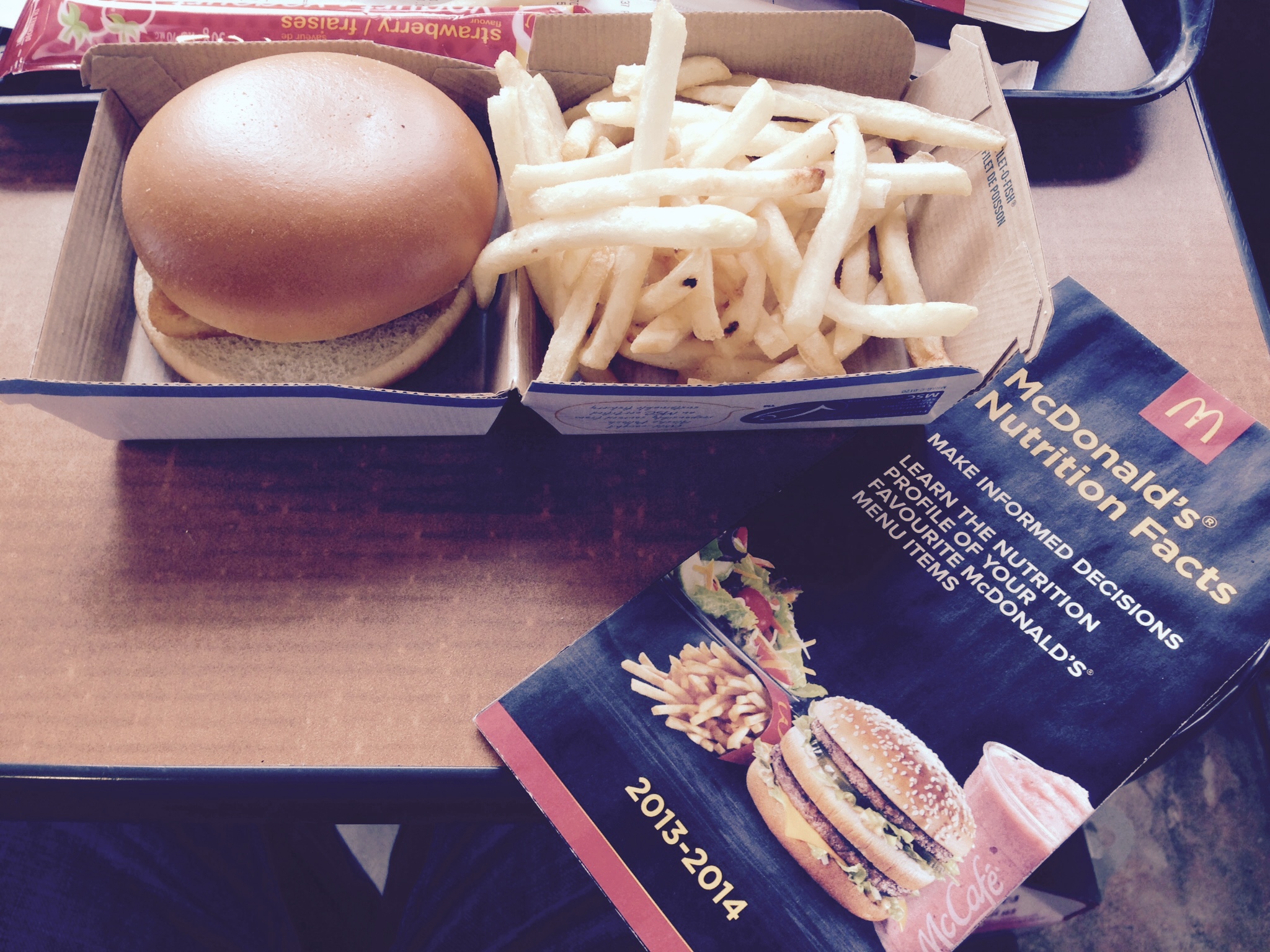
Alright, so maybe I shouldn’t be outing myself as a more-frequent-than-I-should-be customer of McDonalds, but today’s visit was interesting for several reasons. Firstly, my order was taken by an old CW Jefferys student of mine who’s doing a paid co-op placement, so we got to catch up and talk about her plans after high school. Also, I learned that my Filet-o-Fish (pictured above) was made with MSC-certified sustainably-sourced wild Alaskan Pollock, which basically means that it’s a bit better for me than farmed fish, the fish lived decent lives and weren’t fed junk like GMO corn or soy. Also, all sorts of math can be done using the McD’s own nutritional information, not only to learn math concepts, but also to use the math to raise awareness of making informed decisions about the food students choose to eat.
For instance, have students create three meals (breakfast, lunch and dinner) that they would enjoy eating, and then calculate the percentage of daily intake for calories, fat, etc. according to Canada’s Food Guide. Then, have students create three healthier (and I do use that term loosely) meals from the list of McDonalds food items and see the difference in the percentage of caloric and nutritional intake. I’m quite sure that plenty of questions about what is/isn’t healthy will abound in this exercise, which is an important lesson in and of itself. I’ve always thought about trying something like this with my Grade 9s. Now that I’ve thought it through a bit more, sounds like it’s definitely worth doing next time around.
I am a high school mathematics teacher who’s taught primarily in the northwest corner of Toronto. Currently, I serve as the Coordinator of Secondary Mathematics and Academic Pathways in the Toronto District School Board. My role is to support the TDSB with challenging academic streaming from K-12, paying particular attention to inclusive and culturally responsive mathematics instruction. I view math education through the perspective of equity, inclusion and anti-oppression and its intersection with student identities. As a powerful tool and vehicle for social change, I see math as student empowerment and ensure they see its learning as a social enterprise that challenges them to think critically and collaboratively.
I am also a staunch advocate for the elimination of streaming in education — that is, the separation of students into distinct learning pathways based on students’ perceived abilities and identities. I have worked at the school and system levels to support teachers with inclusive math practices and shape policy to remove streaming as a structure barrier to equity and inclusion. I also serve on the steering committee for the Coalition for Alternatives to Streaming in Education, or CASE, a grassroots alliance of community groups wanting to see changes to streaming structures in the school system.
My passion for equity and anti-racism led me to co-author Addressing Anti-Asian Racism: A Resource for Educators, which provides a historical context for anti-Asian racism, the need to work in allyship to dismantle anti-Black and anti-Indigenous racism by tackling white supremacy, and gives teachers and principals practical steps to make anti-oppressive educational spaces.
When I need to step away from the world of education, I play NHL94 for the Super Nintendo, where I compete online as TheProfessor and ranked in the top 5 on Earth (yes, my proficiency in a 25+ year-old video game is an integral part of my identity). My family and friends fit in there somewhere too.
Connect with me on Twitter: @Jason_To
View all posts by Jason To
Published
One thought on “Inspiration from McDonalds”
This is a great example of turning real-life experiences into meaningful math learning. Using McDonald’s nutrition data to build critical thinking is a smart approach. I often check menu and nutrition details on sites like Mc Prices, so it’s interesting to see how this information can be used in the classroom.

 Jason To
One thought on “Inspiration from McDonalds”