I am a high school mathematics teacher who’s taught primarily in the northwest corner of Toronto. Currently, I serve as the Coordinator of Secondary Mathematics and Academic Pathways in the Toronto District School Board. My role is to support the TDSB with challenging academic streaming from K-12, paying particular attention to inclusive and culturally responsive mathematics instruction. I view math education through the perspective of equity, inclusion and anti-oppression and its intersection with student identities. As a powerful tool and vehicle for social change, I see math as student empowerment and ensure they see its learning as a social enterprise that challenges them to think critically and collaboratively.
I am also a staunch advocate for the elimination of streaming in education — that is, the separation of students into distinct learning pathways based on students’ perceived abilities and identities. I have worked at the school and system levels to support teachers with inclusive math practices and shape policy to remove streaming as a structure barrier to equity and inclusion. I also serve on the steering committee for the Coalition for Alternatives to Streaming in Education, or CASE, a grassroots alliance of community groups wanting to see changes to streaming structures in the school system.
My passion for equity and anti-racism led me to co-author Addressing Anti-Asian Racism: A Resource for Educators, which provides a historical context for anti-Asian racism, the need to work in allyship to dismantle anti-Black and anti-Indigenous racism by tackling white supremacy, and gives teachers and principals practical steps to make anti-oppressive educational spaces.
When I need to step away from the world of education, I play NHL94 for the Super Nintendo, where I compete online as TheProfessor and ranked in the top 5 on Earth (yes, my proficiency in a 25+ year-old video game is an integral part of my identity). My family and friends fit in there somewhere too.
Connect with me on Twitter: @Jason_To
Today, I did something that I haven’t done since my family got our first car four years ago – I filled up the tank with sub-90-cent gas. Oddly, in addition to feeling the obvious joy for saving money, I felt a momentary sense of worry about turning into a liberated gas-guzzler. Like many others, my driving habits reflected the tough times of $1.30/L fuel – I drove less, travelled to more local options, and conserved gas however I could (e.g. opening the windows instead of using the air conditioning). Now that gas feels like a bargain, I fear that I and others like me will start taking long joy rides with the AC blasting for no good reason (even in the dead of winter), and in so doing, contribute even more of those nasty greenhouse gases I’ve heard a bit about to Mother Earth. After all, the whole reason fuel-efficient, hybrid and electric cars came to be is due to the economic pressures that came with high fuel prices, and not for any environmental considerations. Money drives behaviour, unfortunately. When it comes to low gas prices, it’s not all roses and rainbows.
So what’s the educational spin in all this? Students should be encouraged to explore all sides of any issue. Role playing and debating are some simple ways to promote critical thinking. This coming semester, I’ll be incorporating social justice issues into math, and no doubt there’ll be some serious debating happening.
In the meantime, I’ll try to enjoy the low gas prices and, well, walk, We’ll see how that goes, as I stare at a snowstorm out the window.
Alright, so maybe I shouldn’t be outing myself as a more-frequent-than-I-should-be customer of McDonalds, but today’s visit was interesting for several reasons. Firstly, my order was taken by an old CW Jefferys student of mine who’s doing a paid co-op placement, so we got to catch up and talk about her plans after high school. Also, I learned that my Filet-o-Fish (pictured above) was made with MSC-certified sustainably-sourced wild Alaskan Pollock, which basically means that it’s a bit better for me than farmed fish, the fish lived decent lives and weren’t fed junk like GMO corn or soy. Also, all sorts of math can be done using the McD’s own nutritional information, not only to learn math concepts, but also to use the math to raise awareness of making informed decisions about the food students choose to eat.
For instance, have students create three meals (breakfast, lunch and dinner) that they would enjoy eating, and then calculate the percentage of daily intake for calories, fat, etc. according to Canada’s Food Guide. Then, have students create three healthier (and I do use that term loosely) meals from the list of McDonalds food items and see the difference in the percentage of caloric and nutritional intake. I’m quite sure that plenty of questions about what is/isn’t healthy will abound in this exercise, which is an important lesson in and of itself. I’ve always thought about trying something like this with my Grade 9s. Now that I’ve thought it through a bit more, sounds like it’s definitely worth doing next time around.
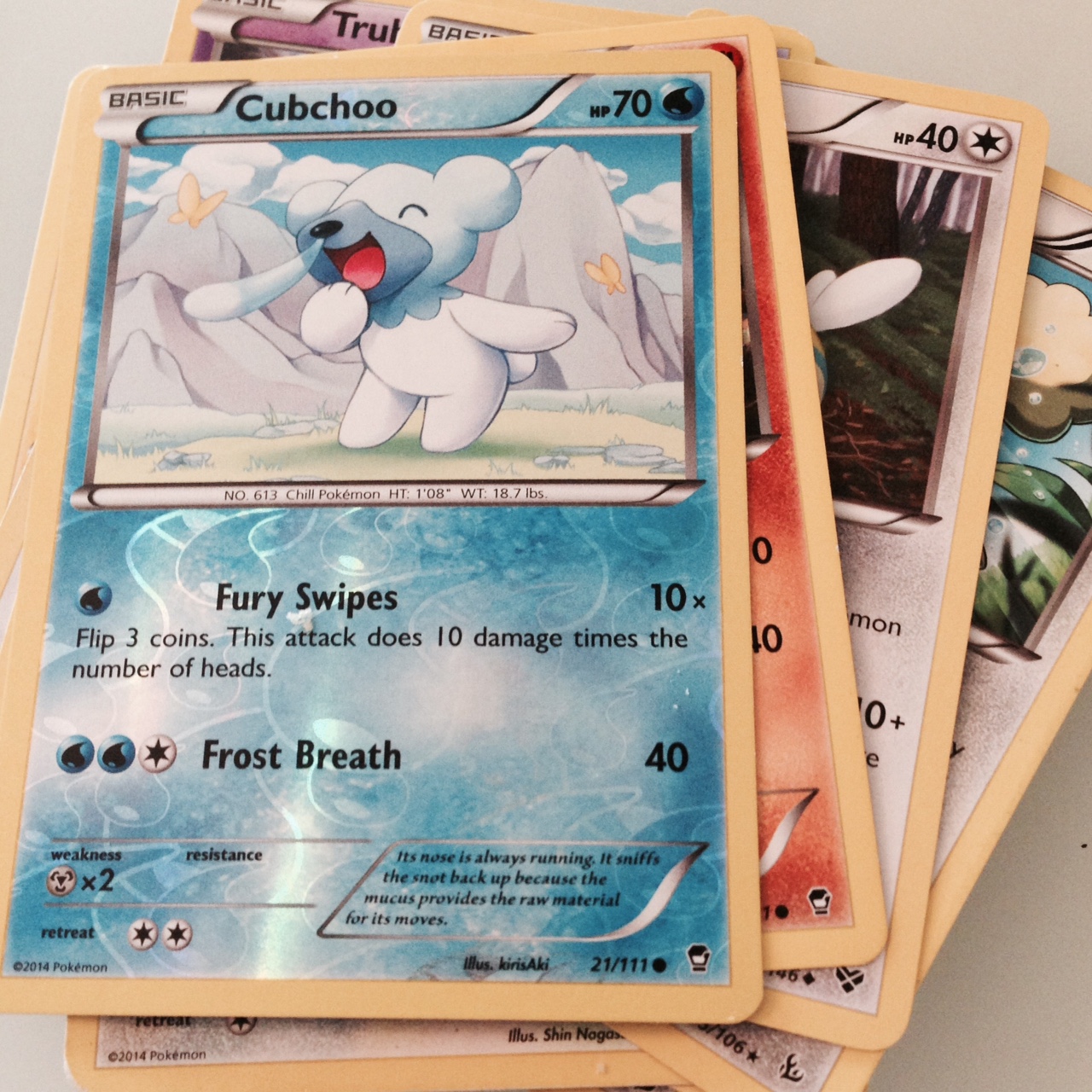
If you are like me and a proud parent of a 7-ish year-old boy, you’ve no doubt encountered Pokemon cards – you may have even been completely into them yourself as a youth (personally, I was more into Power Rangers). These cards with pictures of strange animal-like creatures are part of a trading card game similar to Magic, and my son LOVES them. So, why not try to make the most of this often expensive interest and make it educational? For the past few months, rather than playing the real rules of the card game, we play with them by taking turns “battling” each other’s Pokemon with their attacks and associated amount of damage until the opposing Pokemon’s health points (HP) are reduced to zero. Needless to say, this involves plenty of subtraction using mental math. I’ve noticed that after several months of playing, my son’s subtraction skills are getting stronger – he even explains what he’s doing in his head after each calculation. Plus, he’s willing to do this for, like, an hour or two. It’s amazing how much learning kids will do if the activity is a game or using something that they’re totally interested in. That’s what I’ll be bringing back to my classroom after the winter break. Whether it’s basketball, dancing, or Pokemon cards (my Grade 9s LOVE Pokemon, too), make math fun and relevant.
short·cut (noun \ˈshȯrt-ˌkət also -ˈkət\): a method or means of doing something more directly and quickly than and often not so thoroughly as by ordinary procedure (via merriam-webster.com).
Who doesn’t love a good shortcut? If you use them, you get places faster, get more things done, or do something at a fraction of the time. But, as the above definition suggests, shortcuts are often not as good as the original thing. Unfortunately, with respect to mathematical procedures, the same holds true. I’m personally a math teacher who’s big on teaching for understanding rather than simply to be proficient, and so I never EVER show my students the “shortcuts” that work but don’t follow any mathematical principles. Sure, they do the job okay, but I feel that they come at the expense of students understanding and/or consolidating mathematical rules. Besides, a few of these shortcuts don’t actually save any time, steps, or pencil lead anyway, so why do they persist? My guess is because teachers today were taught the same shortcuts when they were students back in the day, and so we teachers perpetuate the same ill-advised methods to the next generation because, well, they work.
There are two such shortcuts I have identified (though definitely not the first person to do so) that I am on a mission to remove from the face of the Earth. I will show definitively that the more mathematically-sound procedure is actually just as fast, if not faster, than the traditional shortcut. Note: don’t worry if you’re not a math whiz – chances are you’ve been taught these shortcuts before so some of this will ring a bell.
Bad Shortcut #1: Solving equations by moving terms to the other side of the equation (i.e. the Magic Portal Method)
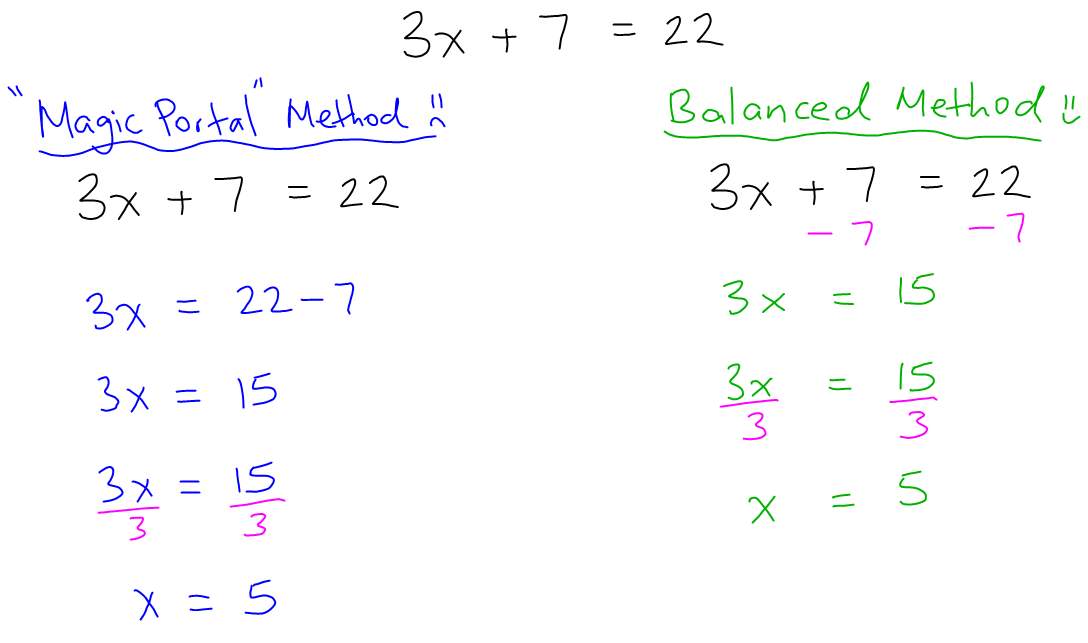
So, the premise is this: to solve a linear equation, such as 3x + 7 = 22, you would first need to remove the 7 from the left side of the equation in an effort to isolate the variable, x. How have most students (including I) been taught to do this? Well, we simply move the +7 to the other side of the equation and change the sign so that it’s now -7. But here’s the issue: why does the sign get to change when a term moves to the other side of an equation? Is the equal sign a gateway to some sort of magic portal that transforms positives to negatives, goodness to evil, or Rob Ford to a respectable political figure? Of course not. There is no justification for changing signs. This is a shortcut without a mathematical leg on which to stand, and yet it is so widely popular (strangely, I can’t find a consistent name for this shortcut, so I’ll refer to it from now on as the Magic Portal Method – trademark). Yes the method works, but when you really think about it, it actually doesn’t make any sense! Why not do something that DOES make sense?
Solution to Bad Shortcut #1: the Balanced Method
As a recap, equations are math statements with two sides showing that two expressions are equal. If one side of an equation is altered, the same change must be made to the other side in order for the expressions to remain equal. If 5 is added to one side of an equation, then 5 must be added to the other side in order for the balance to be maintained. This is the essence of solving equations using the Balanced Method. The mantra that I chant with my students is: “Whatever you do to one side of an equation, you do the same thing to the other side,” which is mathematically valid. Terms are removed from an equation by performing inverse operations (i.e. doing opposite things). In other words, we undo whatever is happening in an equation. To show how the Balanced Method compares to the Magic Portal Method, here are the solutions to solving 3x + 7 = 22 using both approaches:
Using the Balanced Method, the first step is to remove the +7 by subtracting 7 on both sides of the equation. When comparing to the Magic Portal Method, the Balanced Method actually one fewer step AND makes sense mathematically. You get to have your cake and eat it too.
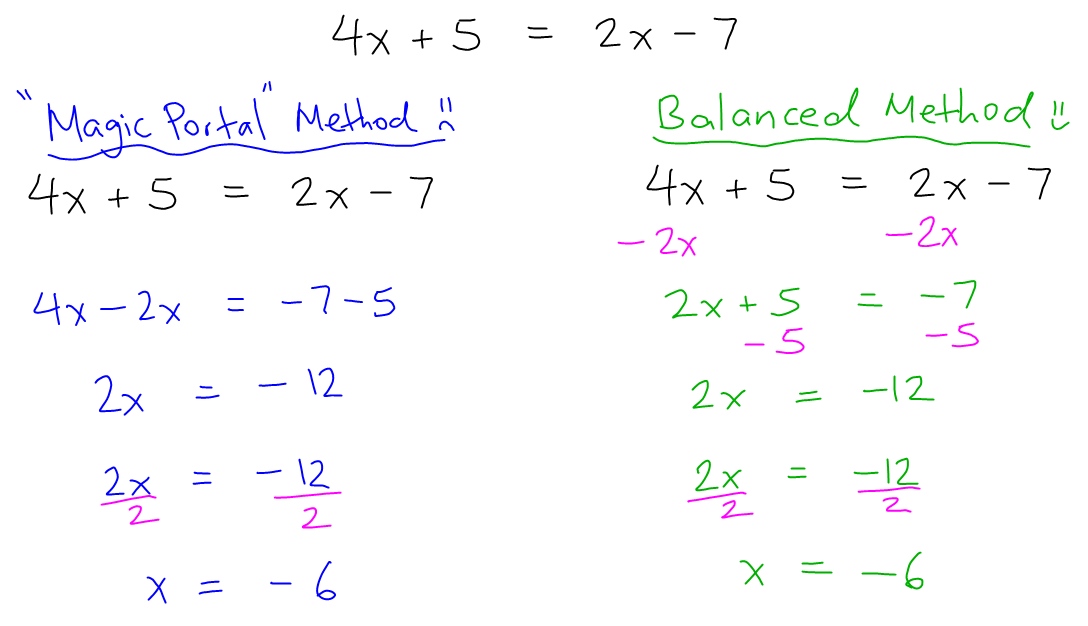
What if there are variables on both sides of the equation? Let’s see:
As you can see, the Balanced Method uses the same number of steps as the “shortcut.” Also, note that in the solution using the shortcut, the Balanced Method is actually utilized at the end (dividing both sides by 2). Why should we use two different strategies when one will suffice?
Whenever students share with me that they have learned to solve equations by moving terms to the other side and switching signs, I ask them why they are allowed to do that. Their most common response: “Uhhh…just ’cause.” We math teachers are not doing students favours by promoting nonsensical tricks that don’t actually help with making life easier. If the Magic Portal Method isn’t really a shortcut AND it doesn’t make sense mathematically, then maybe we as math teachers should reconsider sharing it with our students and instead focus on the more mathematically-favourable Balanced Method as a way to solve equations.
Bad Shortcut #2: Solve a proportion by cross-multiplying
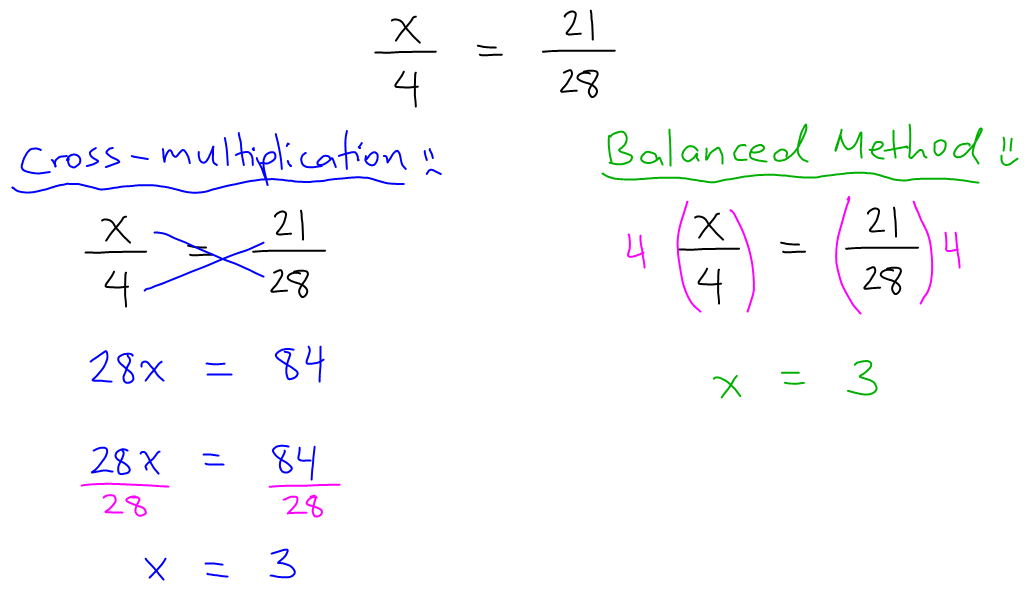
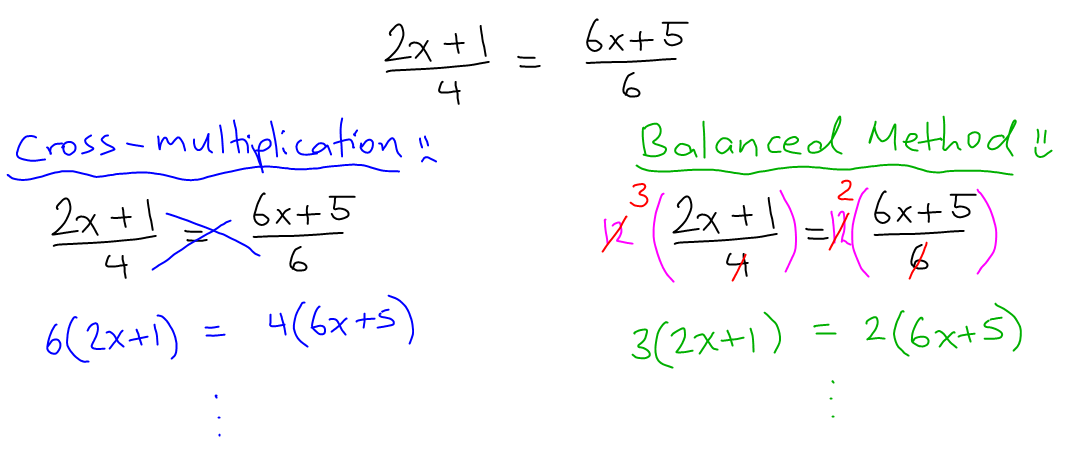
Okay, so this is also technically solving equations, but when two fractions are equated, such as x/4 = 21/28, we’ve been historically taught to use another little trick to solve buggers like this: cross-multiplication. Simply put, the first step to cross-multiplication is to multiply the numerator of one fraction with the denominator of the other fraction and make the products equal. Similar to moving terms to the other side of an equation, this procedure is also without merit. Again, this method works, but math students typically do not know why they can do it, and that’s the main problem. Let’s contrast the cross-multiplication solution to x/4 = 21/28 with one using the Balanced Method:
Well, this is embarrassing. It seems that the Balanced Method provides the Usain Bolt of solutions, while the cross-multiplication solution is more like an injured mule. Clearly, the shortcut is the long-cut here. You may wonder how the Balanced Method can be used if the variable is in the denominator rather than in the numerator. All you would have to do is take the reciprocal of both sides to fix that issue (i.e. flip both fractions upside-down):
Same number of steps. Short-cut, shmort-cut.
So there you have it. It appears that moving terms to the other side of an equation and cross-multiplication are techniques that not only students use without any understanding, but they also don’t even make math any quicker. By instead focusing on the universal approach of the Balanced Method, math teachers can promote a sound understanding and a better way to solve equations. Let’s not share the poor methods of our forefathers and break the cycle of ineffective math skills.
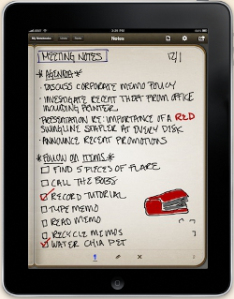
We, as tech-loving teachers, have all heard this statement before: “Just think of all the money you’d save by going paperless!” With iPads dominating the education technology landscape as the go-to alternative to paper, teachers across the world are pleading with their school administrators for more funds in order to make the transition from paper to PDFs and handouts to handhelds. Not only would this save trees, many argue, but also a ton of money. But is this premise true? Are the costs of purchasing and maintaining iPads offset by the savings produced by eliminating paper and photocopies? I sought to get to the bottom of this, and the results may be surprising.
The “True” Cost of an iPad
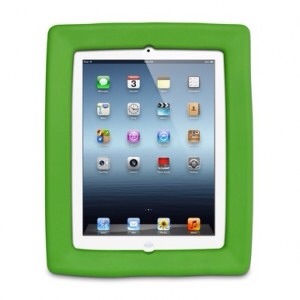
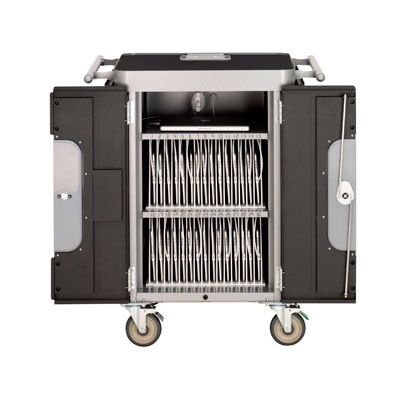
A few assumptions must be made in order to proceed with calculating a “true” cost of an iPad. First, let’s assume that, in addition to a bulk purchase of 30 iPad Air (16GB) units, each unit will require a protective case and a storage option. In terms of storage, most educators will insist on a powered cart for ease of charging, syncing, and security.
Finally, to make a fair comparison of costs between iPads and paper handouts, let’s calculate the average cost of both options for one student per school period, assuming an instructional day consisting of four periods, and 180 instructional days a year (or 90 per semester).
All the prices that I’ll be using are based on those listed in the TDSB’s purchasing catalogues. So, without further ado, let’s go shopping:
30 iPad Air (16 GB) (@ $5005 for 10 units x 3): $15,015.00 30 Big Grips Slim Frame cover (@ $31.92 each): $957.60 Bretford PowerSync Cart: $2799.95 Total Cost: $18,772.55 Total Cost per period, per student, for 3 year life-span: $0.2897
This cost per student, $0.2897, for an iPad for every school period is likely an underestimation, as this assumes a 100% use rate for the iPads and does not take into account the inevitable costs of repairs and replacement units.
The Cost of Handouts
I must confess – I give lots of handouts to my students. Many of my math lessons involve pre-made slides using an interactive whiteboard, so I give students the unannotated slides on handouts so they can easily follow along and focus on the learning activities, rather than vigorously scribbling every word and getting distracted from discussions. For some classes, these handouts are four pages in length (two pieces of paper printed on both sides), but often reach up to eight pages if I’m providing practice questions. So, for the paper handout calculations, let’s assume the high end of the spectrum and go with eight pages of handouts per student per class.
So, exactly how much does a photocopy cost? According to the TDSB photocopier price book, “The cost per copy is $0.01183. This cost includes; equipment, all supplies except paper and staples, all service and repair costs including parts, labour, delivery, pick-up, rigging and other related charges, plus all training costs.”
Okay, so what about the cost of the paper and staples? Thanks to my school’s budget secretary, I found that a box of 5000 sheets can be purchased for $39.74 (or $0.007948 per sheet), a rather reasonable price. However, what really shocked me was the price of the photocopier staples: 25000 for $213.30! That’s $0.008532 per staple, which is greater than the cost of a sheet of paper. Comparing that to a box of 5000 conventional staples for $0.83, the photocopier staples are over 50 times the price! Bananas.
Anyway, back to the cost of a handout, consisting of eight copies, four sheets of paper, and one photocopier staple:
8 copies (@ $0.01183 per copy): $0.09464 4 sheets of paper (@ $0.007948 per sheet): $0.03179 1 photocopier staple (@ $0.008532 per staple): $0.008532 Total Cost per Student: $0.1350
Compare this to the cost per student per period for the iPads, $0.2897, and it’s clear that iPads actually cost over twice as much as paper handouts.
Other Considerations
Of course, iPads offer much more than just an alternative to paper. The value added from the myriad of other functions and capabilities is really what makes the iPad (and other tablets) the revolutionary educational tools that they are professed to be. The question is whether the added cost is worth it? Depending on the type of use, the answer can go either way; any use that’s on the lower end of the SAMR model of technology use would not justify the cost.
From an environmental and ethical standpoint, it would seem wise to consider the switch from paper to iPads. After all, the plight of forests and the environmental and ecological impact due to paper production is widely known. However, the production of iPads is not without its share of controversy. Notably, the minerals used to create iPads were sourced from countries that would use the revenue to finance war. However, Apple has recently made aggressive efforts to reduce the use of such “conflict minerals,” but cannot confirm the end of their use.
Conclusions
Let’s get back to the main question: does it make sense from a financial standpoint to switch from paper handouts to iPads? I would say no, unless teachers are committed to using them at or near 100% of the time and take advantage of their enormous capabilities. Then one can argue that the cost of iPads would be worth it. Before taking the plunge and “investing” $18,000 towards iPads, be sure to have a plan, or else you might just end up using the iPad cart as an extra surface to organize your eight-page handouts.
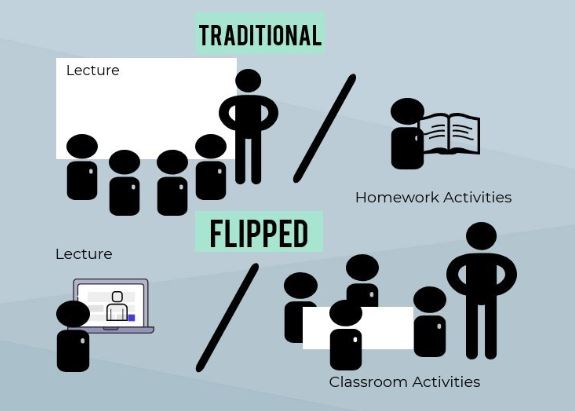
This past November, after much research and debate with my inner voice, I decided to take the leap and implement the “flipped learning” model of teaching in my second-semester Grade 9 Academic Math class. My reasoning was three-fold:
I wanted more time in class to assist my students. I strongly feel that immediate and personal feedback is critical to successful learning. Also, students learn much more from “doing” than from “watching.” So, the idea of having an entire 75-minute period for me to talk to students and for students to work after watching a video lesson the night before was a huge plus.
I wanted non-traditionalhomework. From my experience teaching at inner-city schools, I have learned that a significant proportion of students are not willing/able to complete traditional homework. Therefore, I felt that if homework involved watching and following along with a video on YouTube, something that many of my students already do, it would increase the likelihood of students completing the task.
I wanted to level the playing field. Historically, students at my school have performed far below average on the provincial standardized assessment of mathematics. This is due to a myriad of reasons, many of which come from the fact that my school, Westview Centennial Secondary School, has the second-neediest student population of any high school in the Toronto District School Board. I felt that the nature of the flipped learning model could help close this achievement gap, particularly for students at the lower end of the academic scale.
So, for the next few months, I spent hours at a time preparing video lessons and planning class activities now that a greater amount in-class time would be allocated to students actively working and learning. I organized my content on Desire2Learn, fully equipped with quizzes that students could try after viewing a video as a self-assessment tool. In my mind, it was all going to be glorious, and for the first week, it was going great. Every student was watching the video and some were taking the online quizzes, but everyone was coming to class ready to work on problems and participate in class activities. However, after this honeymoon phase, I realized that my glorious plan was starting to crumble. Fewer and fewer students were coming to class prepared and almost no one was trying the quizzes, so students had to watch the videos during class time and hence defeating the purpose of flipped learning. I didn’t want things to become punitive (and I’m not that kind of teacher), so I just continued to encourage everyone to view the videos and come to class ready. After two months, and things seeming to hit a wall, I took a step back and evaluated the situation. I came up with several conclusions:
Flipped homework is still homework. Even though the homework was watching a video on YouTube, some students still came to class without completing the task. If a student doesn’t complete the traditional homework of practice math questions, at least they probably learned something while in class. However, if a student doesn’t complete their flipped homework, they haven’t learned anything, and they arrive in class knowing nothing! Needless to say, this was extremely frustrating.
The flipped learning model works really well for students with high motivation to learn, and doesn’t work very well for students with low motivation. When I went around asking students if they enjoyed the flipped learning model, the biggest supporters were the students whom I would describe as highly motivated to learn and succeed. Students who were lukewarm or opposed to flipped learning were those who struggled with other subjects in school. From my observations, the students that regularly came to class unprepared were also those who weren’t likely to complete traditional homework, which leads me to believe that the flipped model may deepen the divide between engaged and disengaged students.
Some topics are better taught in-person. After many consecutive weeks of flipping algebra, I decided to teach scatter plots in-person because I had prepared lessons from a year ago that worked very well. This time, they worked very well! From that experience, I realized that maybe I shouldn’t flip all the time, and only flip when I feel that I need more time in class to further develop a topic.
Where I stand now: I’m usually not one to abandon ship, but after reflecting on how the past few months have played out, I am going back to my teaching ways prior to flipping (which I think was pretty good to begin with :)). Maybe I’m not doing it right, but I believe that the flipped model just doesn’t jive with my group of students as a whole. However, my next plan is to try the flipped model with a Grade 12 Data Management class. Why? I feel that a more mature crowd will embrace the benefits of flipped learning more. Also, my primary goal is to create a curriculum for the course that revolves around social justice issues, so I feel that more time is needed in class to discuss those themes, and the flipped model can provide me with just that.
What do you think? What are your experiences with flipped learning? Have you made flipped learning successful in a school with a lower-income population? Let me know! I’d love to get your feedback.





 Jason To